When a property manager collects rent, that money does not belong to the management company. It belongs to the owner, subject to a fee the manager has earned. The same is true of security deposits, which belong to tenants until the lease terminates and a lawful deduction is made.
That is the whole basis of trust accounting, and it is why the rules around it are stricter than ordinary business bookkeeping. State real estate regulators treat trust account handling as a licensing matter, and the striking pattern in disciplinary records is that most violations are not theft. They are shortfalls created by sloppy records, late reconciliation and fees withdrawn on the wrong basis.
Knowing whose money is in the account
A trust account is a single bank balance holding many people's money simultaneously. The bank sees one number; you must be able to break that number into named parts at any moment.
A typical trust balance contains:
- Rent collected but not yet disbursed to owners
- Security deposits held for tenants
- Owner reserves held for maintenance and expenses
- Prepaid rent for future periods
- Application fees not yet earned
- Funds held pending resolution of a dispute
Every one of those needs its own ledger. The individual ledgers, added together, must equal the bank balance — and when they do not, the difference is either an error or a shortfall, both of which are problems.
Many states require security deposits to be held in a *separate* trust account from operating rent funds. Where that applies, the deposit account has its own reconciliation and its own ledgers, and the statutory rules in security deposit law apply on top of the trust rules.
Commingling: what it actually covers
Commingling is the offence most managers believe they are not committing. It runs in both directions and does not require any client to be harmed.
- Client money into firm accounts. Depositing a rent cheque into the operating account, even for an hour, even if transferred immediately.
- Firm money into trust. Beyond a small permitted balance to cover bank fees, where a state allows one at all.
- Paying firm expenses from trust. Payroll, rent, software — regardless of intent to reimburse.
- Leaving earned fees in trust. Once a management fee is earned it is firm money, and most states require prompt withdrawal.
- Paying one client from another's funds. Covering Owner A's repair from Owner B's balance is a shortfall even if it nets out later.
That last one deserves emphasis, because it is where good intentions do the most damage. If an owner's ledger goes negative, the money funding that negative balance came from another client. Regulators treat a negative client ledger as evidence of a trust shortfall, full stop.
A negative owner ledger is not an overdraft. It is someone else's money, spent without their knowledge.
The three-way reconciliation
This is the core control, required monthly in most jurisdictions. Three independently maintained figures must agree.
| Balance | Source | What it represents |
|---|---|---|
| Adjusted bank balance | Bank statement, adjusted for outstanding items | What the bank actually holds |
| Book balance | Your trust cash journal | What your records say is held |
| Total client ledgers | Sum of every individual ledger | What is owed to each client |
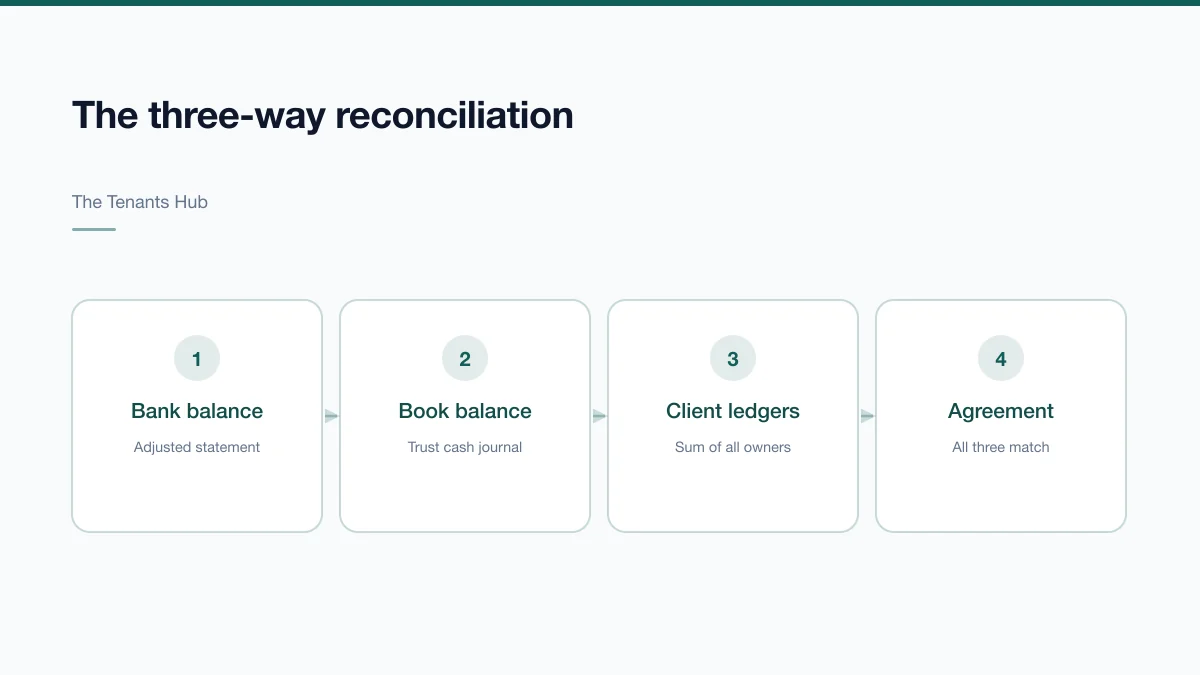
Running it each month:
- Take the closing bank statement balance
- Add deposits in transit and subtract outstanding cheques to get the adjusted bank balance
- Compare against the trust cash journal balance and investigate any difference
- Print every client ledger and total them
- Confirm the ledger total equals the adjusted bank balance
- Confirm no individual ledger is negative
- Document the reconciliation, sign and date it, and retain it
The pattern of disagreement is informative. Bank versus book usually means unrecorded fees, timing differences or a posting error. Book versus ledgers usually means a transaction hit the account without being allocated to a client — which is the more serious of the two, because it means money is in the account with no identified owner.
Management fees and owner payouts
Fee handling is where otherwise careful firms most often slip. A management fee becomes firm money only when it is earned under the management agreement — usually when rent is actually collected, not when it falls due.
Taking a fee on rent that has been billed but not received means withdrawing money that currently belongs to someone else. Taking it early on a tenant who then pays late is the same problem with better intentions.
A defensible payout cycle looks like this:
- Rent is received and posted to the specific tenant and lease
- Funds credit the owner's trust ledger
- Property expenses are paid from that owner's ledger only
- The management fee is calculated on collected rent and transferred to the operating account
- A reserve is retained per the management agreement
- The remaining balance is disbursed to the owner
- An owner statement is issued showing every line of the above
The statement is not a courtesy. It is the record demonstrating that funds were handled as the agreement requires, and it is what an auditor reads alongside the ledger.
Records regulators expect
- A trust cash journal recording every receipt and disbursement in date order
- An individual ledger for every owner, tenant deposit and reserve
- Signed monthly three-way reconciliations, retained for the state's required period
- Bank statements, deposit slips and cancelled cheque images
- Executed management agreements defining fees, reserves and disbursement terms
- Documentation for every fee withdrawal, tied to the collections it relates to
- Owner statements as issued
- A record of who is authorised to sign on the account
Retention requirements commonly run three to seven years depending on the state. Audits are frequently unannounced, and the reconciliation file is usually the first thing requested — an examiner who finds twelve signed monthly reconciliations forms a very different early impression from one who finds four.
Controls worth having
- Separation of duties — the person recording transactions should not be the only person reconciling them
- Dual authorisation above a defined disbursement threshold
- A monthly review of every ledger for negative balances, not just the total
- A written policy for handling unidentified deposits, including a holding ledger
- A hard rule that no disbursement is made against uncleared funds
- A reconciliation deadline early enough in the month that problems surface while they are still small
The recurring theme in enforcement cases is delay. A firm that reconciles monthly finds a misposting within thirty days, when it is a correction. A firm that reconciles sporadically finds it a year later, when it is a shortfall spanning many clients and looks very different to a regulator.
The Tenants Hub tracks payments, expenses and owner payouts against individual property and owner records, so per-owner balances and payout history stay separated by construction rather than by manual discipline. That does not replace your reconciliation process — but it removes the main source of the errors that reconciliation exists to catch. For the wider accounting picture, see rental property bookkeeping.