Rental bookkeeping goes wrong structurally, not arithmetically. The transactions get recorded; they are simply recorded in a way that cannot answer the questions asked of them — which property is actually profitable, what did that renovation cost in total, and what belongs on which line of the tax return.
Fixing the structure is a one-time effort that pays back every year afterwards. This covers the account structure, the classification decisions that matter most, and how the result maps onto a US Schedule E.
Separate the money first
Before any account structure matters, the banking has to be right. Rental income and expenses need their own account — not a shared one with personal spending, however carefully you plan to sort it later. Reconstructing a year of mixed transactions is the most common reason landlords lose deductions they were genuinely entitled to.
A workable structure for most portfolios:
- An operating account per entity, receiving rent and paying operating expenses
- A security deposit account, held separately where state law requires it — see security deposit rules
- A reserve account for capital replacements, funded on a schedule rather than when something fails
- A dedicated card for property expenses, so receipts and statements align
If you manage property for other owners, this is a compliance obligation rather than a preference — client funds must be held in trust and never commingled. Trust accounting for property managers covers those rules.
A rental chart of accounts
The goal is to align your categories with the tax form you will eventually file, so that year-end is a summary rather than a reclassification exercise.
Income
- Rental income — base rent
- Late fees
- Pet rent and pet fees
- Parking and storage income
- Utility reimbursements
- Application fees
- Forfeited deposits — recognised when retained, not when received
- Other income — lease break fees, key replacement
Operating expenses
- Advertising and leasing
- Auto and travel
- Cleaning and maintenance
- Commissions and management fees
- Insurance
- Legal and professional fees
- Mortgage interest
- Other interest
- Repairs
- Supplies
- Property taxes
- Utilities
- HOA and condo fees
- Depreciation
Those categories are deliberately close to the Schedule E expense lines. Keeping them aligned means the annual return is largely a matter of running a report per property.
Repairs versus improvements: the line that matters most
This single distinction affects more tax dollars than anything else in rental bookkeeping. A repair is deducted in full this year. An improvement is capitalised and recovered over decades.
The general test asks whether the work betters the property, restores it substantially, or adapts it to a new use. If it does any of those, it is likely an improvement. If it merely keeps the property operating in its existing condition, it is likely a repair.
| Work | Usual treatment | Reasoning |
|---|---|---|
| Patching a roof section | Repair | Maintains existing condition |
| Full roof replacement | Improvement | Restores a major component |
| Repainting a unit at turnover | Repair | Ordinary upkeep between tenancies |
| Replacing a broken window | Repair | Restores existing function |
| Whole-house window replacement | Improvement | Betterment of a building system |
| Fixing a dishwasher | Repair | Maintains existing asset |
| New dishwasher | Improvement | New asset, shorter recovery period |
| Kitchen renovation | Improvement | Betterment |
| Unclogging a drain | Repair | Routine maintenance |
| Repiping the building | Improvement | Restores a building system |
There are safe-harbour provisions that let smaller amounts be expensed rather than capitalised — a de minimis election, a safe harbour for small taxpayers, and one for routine maintenance. The thresholds and eligibility conditions are specific and worth reviewing with your CPA, because for a small portfolio they can cover a meaningful share of annual spend.
Depreciation and cost allocation
Depreciation is the largest non-cash deduction available to a rental owner, and the one most often set up carelessly at acquisition.
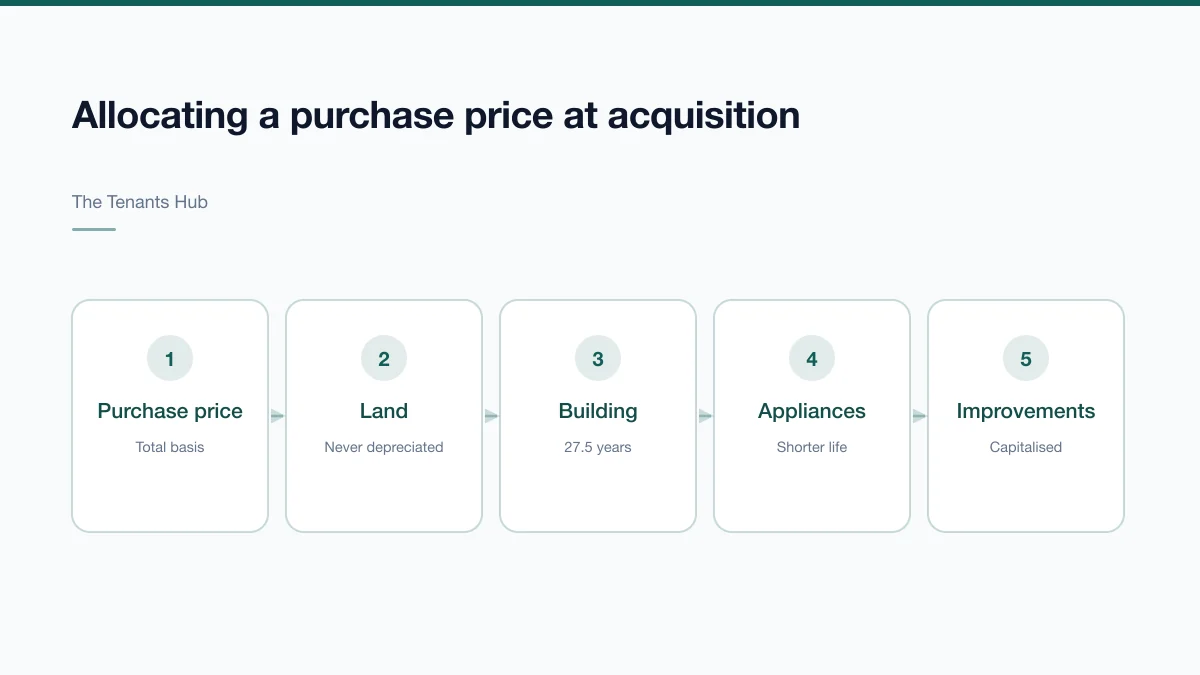
Residential rental buildings are depreciated over 27.5 years, straight line. Land is not depreciable at all, so the purchase price must be allocated between land and building — commonly using the ratio in the county assessor's valuation, documented at the time. Get this wrong at purchase and it is wrong for the entire holding period.
Not everything shares the building's recovery period. Appliances and carpeting typically use a five-year period, and certain land improvements a fifteen-year one. Separating these — rather than lumping everything into the building basis — accelerates deductions legitimately.
Depreciation is recaptured on sale, which is a genuine future liability rather than a permanent saving. That does not argue against claiming it — you are required to reduce basis by depreciation allowable whether or not you claimed it — but it should inform how you think about eventual disposition.
How it maps onto Schedule E
Most individual US landlords report rental activity on Schedule E of Form 1040, with each property reported in its own column — which is precisely why property-level tagging is non-negotiable.
The form asks for the property address, the type, and the days rented at fair rental value versus days of personal use. That last pair matters: personal use of a rental can limit deductions substantially, and the day counts need to come from records rather than recollection.
Passive activity loss rules may limit how much of a rental loss you can deduct against other income in a given year. Losses that are limited are generally suspended and carried forward. Whether you qualify for an exception depends on income level and participation, and is a conversation for your CPA rather than a rule of thumb.
What to keep, and for how long
- Bank and card statements for every account used for the property
- Invoices and receipts for all expenses — capital items especially, which must survive until well after sale
- Signed leases, renewals and addenda
- The rent ledger for each tenancy
- Closing statements from purchase and any refinance
- The depreciation schedule and the original land-to-building allocation
- Contractor 1099 filings and the W-9s supporting them
- Mileage logs for property-related travel
Three years is the common baseline retention period, but records supporting basis — purchase documents, capital improvements, the depreciation schedule — should be kept until several years after the property is sold, because they determine the gain calculation.
The deduction you cannot document is the deduction you do not have.
Vendor reporting is a related obligation: payments to unincorporated contractors at or above the annual threshold generally require a Form 1099-NEC, which means collecting a W-9 *before* the first payment rather than chasing it in January.
Keeping it current
Bookkeeping fails from deferral. Twelve months of receipts and an unreconciled account in March is a far harder problem than fifteen minutes a week, and it is where genuine deductions get lost.
Recording income and expenses against the property and lease as the transactions happen is what keeps the year-end position defensible. The Tenants Hub records payments, expenses and deposits against each property and lease, so per-property income and expense reports are available at any point rather than assembled at the end — including the rent roll that sits alongside them.