Security deposits generate more landlord–tenant litigation than any other single issue, and the striking thing about those cases is how rarely they turn on whether the damage was real. They turn on deadlines, itemisation and proof. Landlords lose deposit cases they factually should have won, because the notice went out on day 32 in a 30-day state, or because "cleaning — $400" was the entire explanation offered.
Deposit law is state law, and it varies more than almost any other area of the landlord–tenant relationship. What follows is the structure common to nearly every state, plus the specific points where states diverge and you need to check your own.
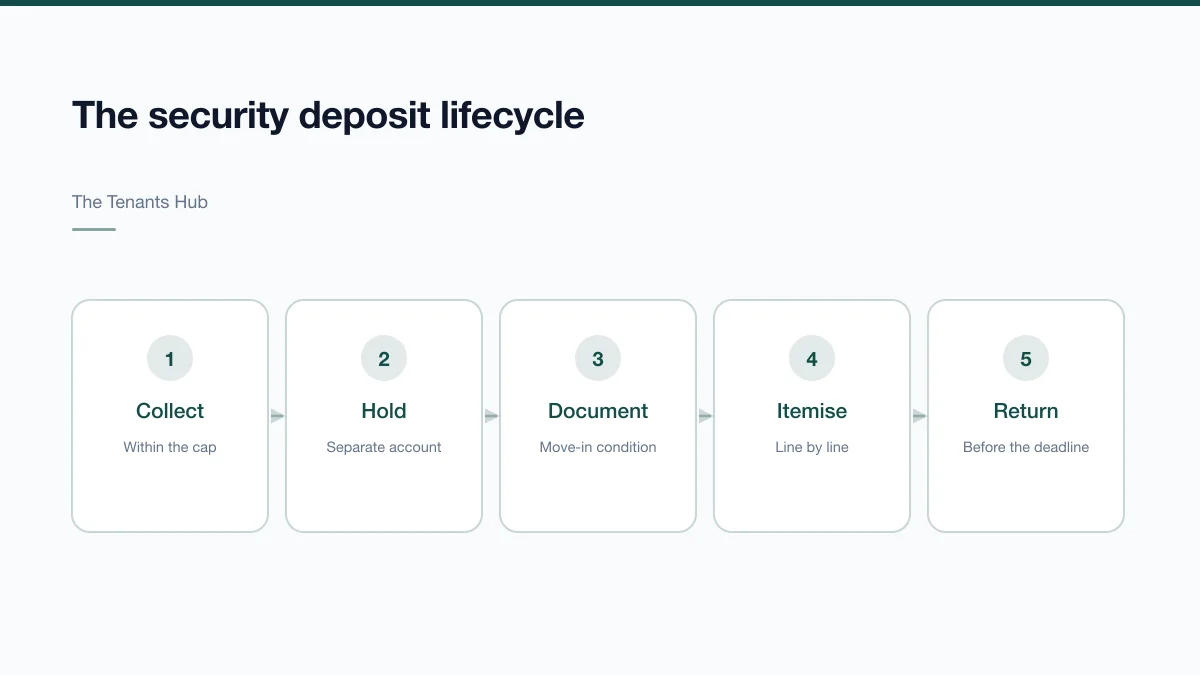
How much you can collect
States fall into three broad camps. Some cap deposits at a multiple of monthly rent — one month and two months are the most common ceilings. Some impose no statutory limit at all and leave it to the market. A third group caps the deposit but allows extras on top, such as a separate pet deposit or an additional half-month for a furnished unit.
Two details catch people out. First, whether the cap counts *all* move-in money or only the refundable portion — in strict states, a non-refundable "cleaning fee" may simply be recharacterised as part of the deposit and pushed over the cap. Second, whether last month's rent collected up front counts toward the limit. In several states it does.
A related trend worth tracking: a growing number of jurisdictions now require landlords to offer an alternative to a lump-sum deposit — instalment payment plans, or a deposit-replacement insurance product — for tenants who request one.
Where the money has to sit
This is the requirement most often missed by smaller landlords, because it costs nothing to comply with and everything to ignore.
- Separate account. Many states require deposits to be held apart from your operating funds. Commingling deposit money with rent income can itself be a violation, independent of whether the tenant was ever harmed.
- Interest-bearing. Some states and cities require the account to bear interest, with the interest paid or credited to the tenant annually or at move-out.
- Written notice of location. A number of states require you to tell the tenant, in writing and within a set period after move-in, the name and address of the institution holding the deposit and the account terms.
- Bond or escrow alternatives. A few states allow a surety bond to be posted instead of holding cash.
If you manage on behalf of other owners, deposit handling sits on top of your state's trust accounting rules for licensees — a stricter regime again. Trust accounting for property managers covers that in detail.
The move-in inspection decides the move-out dispute
You cannot prove a tenant damaged something without establishing its condition when they received it. The move-in condition report is not paperwork for its own sake — it is the baseline that every later deduction is measured against, and without it you are asserting damage against an unknown starting point.
Several states require a written move-in checklist, signed by both parties, and bar you from deducting for anything not documented on it. Even where it is optional, do it.
A defensible condition record includes:
- Date-stamped photographs of every room, including floors, walls, appliances and fixtures
- Close-ups of any pre-existing damage, however trivial it seems
- Meter readings and appliance model or serial numbers
- A written checklist signed and dated by both landlord and tenant
- The same photographic set repeated at move-out, from the same angles
What you can and cannot deduct
The dividing line is between normal wear and tear — deterioration from ordinary use over the length of the tenancy, which the rent is meant to cover — and damage caused by negligence, abuse or accident.
| Item | Usually wear and tear | Usually damage |
|---|---|---|
| Walls | Scuffs, small nail holes, faded paint | Large holes, crayon, unapproved colours |
| Carpet | Traffic-lane wear, mild matting | Burns, pet stains to the pad, tears |
| Appliances | Normal mechanical decline | Damage from misuse or neglect |
| Bathroom | Grout discolouration, worn caulk | Cracked fixtures, untreated mould from neglect |
| Doors and windows | Sticking hinges, worn weatherstrip | Broken glass, forced or damaged frames |
| Cleanliness | Light dust at move-out | Grease, waste or debris requiring deep cleaning |
Depreciation matters and is often overlooked. If a carpet has a useful life of seven years and the tenant destroys it in year five, most courts will let you recover the remaining two years of value — not the price of a brand-new carpet. Billing full replacement cost for a nearly expired item is a common and avoidable way to lose an otherwise valid claim.
Unpaid rent and unpaid utilities are almost always deductible. Costs of re-letting after an early departure sometimes are, depending on the state and on whether you made reasonable efforts to re-rent.
Itemising and returning on time
When the tenancy ends, the clock starts. Whether it starts at lease end, at the date the tenant vacates, or at key return is state-specific — assume the earliest of them and you will not be caught out.
Within the deadline you generally must deliver:
- A written, itemised statement listing each deduction separately with a specific dollar amount
- A description precise enough that the tenant can identify what was repaired and why
- Receipts or estimates, which several states require outright and which are persuasive everywhere
- Any interest owed on the deposit, where the state requires it
- The remaining balance, sent to the tenant's forwarding address
If the tenant left no forwarding address, send the statement to the last known address anyway — usually the unit itself. Most statutes require a good-faith attempt, not successful delivery, and the attempt is what you need to be able to evidence.
What non-compliance actually costs
Deposit statutes are unusually punitive, because legislators recognised that the money is already in the landlord's hands and tenants have limited leverage to get it back.
- Forfeiting the right to claim any deductions, even legitimate documented ones
- Statutory damages, commonly two or three times the deposit amount
- Liability for the tenant's attorney fees and court costs
- In some states, additional penalties for wilful or bad-faith retention
The most expensive deposit mistake is not over-deducting. It is missing the deadline — because that single failure can wipe out every valid claim you had.
Building this into your process
Nothing here is intellectually difficult. It fails in practice because the deadline is short, the move-out is busy, and the documentation lives in three places — photos on a phone, invoices in an inbox, deposit balance in a spreadsheet.
The fix is to attach the deposit to the lease record itself, so the balance, the condition reports and the return deadline travel together and the deadline surfaces as an alert rather than a memory. The Tenants Hub tracks deposits against each lease with move-in and move-out documentation on the same record, and flags the statutory return window as move-out approaches.
Handled properly, the deposit is a routine accounting entry. Handled casually, it is the most likely reason you will end up in front of a judge.