Acquisition gets the attention, but renewals are where a rental portfolio's income is actually determined. A property with sixty percent of its leases renewing each year has most of next year's revenue decided in a handful of conversations — conversations that, for many landlords, consist of a letter sent six weeks before expiry.
Done well, renewals hold occupancy while keeping rents near market. Done badly, they either bleed income through years of untouched rents, or trigger avoidable turnovers that cost more than the increase was worth.
The arithmetic that should drive the decision
Every renewal is the same comparison: the gain from an increase, against the cost of turnover multiplied by the probability that the increase causes one.
Take a $1,800 unit. A $75 increase yields $900 over twelve months. If a turnover costs $4,000 — vacancy, make-ready, marketing, screening, leasing time — then the increase only makes sense if it raises the probability of a move-out by less than about 22 percentage points.
That framing changes intuitions in both directions. It argues against aggressive increases on tenants who are borderline. It also argues against timidity: a $25 increase that carries essentially no move-out risk is free money, and skipping it for three consecutive years is how a unit ends up 15% below market.
A renewal timeline that works
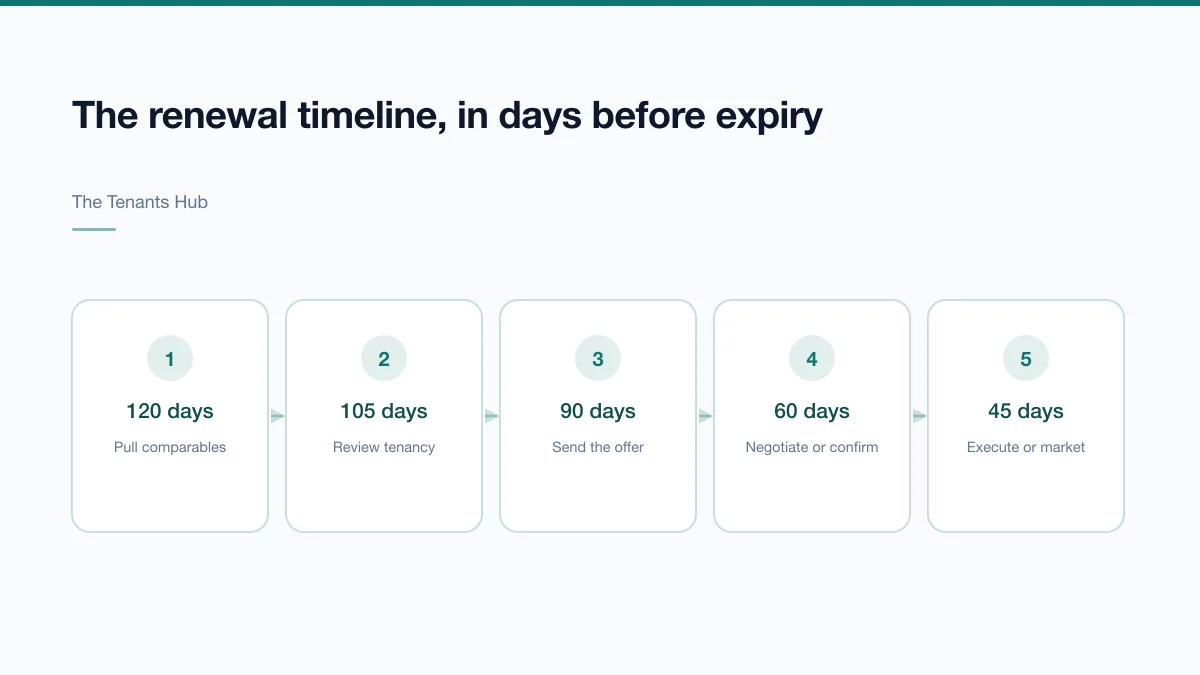
The most common error is starting late. Here is the sequence that gives you options rather than reactions.
| Days out | Action |
|---|---|
| 120 | Pull current market comparables for the unit type |
| 105 | Review the tenancy: payment history, care of the unit, open requests |
| 90 | Send the renewal offer with term options |
| 75 | Follow up if there has been no response |
| 60 | Negotiate, or confirm the tenant is leaving |
| 55 | If not renewing, begin marketing and schedule make-ready |
| 45 | Execute the renewal, or confirm move-out logistics in writing |
| 30 | Renewal signed, or new tenant screening under way |
The value of the 90-day start is what it does at day 55. A landlord who learns of a departure six weeks out is marketing a unit they cannot show properly. One who learns at 60 days can market, screen and often sign a new tenant before the current one has left — compressing the vacancy gap to days.
Setting the number
Start with actual market evidence, not last year's number plus a guess. Look at what comparable units in the immediate area are currently *leasing* for — not asking. Asking rents on stale listings tell you what is not renting.
Then adjust for the specific tenancy:
- Payment history. A tenant who has never been late is worth keeping and worth a smaller increase.
- Care of the property. Inspection history and turnover condition are real financial factors.
- Tenancy length. Long tenancies carry accumulated goodwill and lower risk.
- Current gap to market. A unit already at market has little headroom.
- Season. An expiry in your slowest leasing month makes turnover more expensive, which argues for restraint.
- Unit condition. If you have deferred improvements, a large increase is a harder case to make.
Where a unit has drifted well below market, resist closing the whole gap at once. Staging the correction across two renewals usually nets more total rent than one large increase that produces a vacancy, and it keeps a known-good tenant in place.
Notice requirements are not optional
Rent increase notice is governed by state and often city law, and the required period frequently scales with the size of the increase.
- Month-to-month tenancies typically require at least 30 days' written notice; larger increases often require 60 or 90
- Fixed-term leases generally cannot be increased mid-term unless the lease itself provides for it
- Rent-regulated jurisdictions cap both the increase and the frequency, and may require a specific notice form
- Some jurisdictions require notice of non-renewal, with its own period, separate from any increase
- Delivery method may be prescribed — certified mail or personal service rather than email
A defective notice does not merely delay the increase. In several jurisdictions it voids it entirely for that cycle, and where the tenant has already paid at the higher rate it can create a refund obligation.
How the offer should read
A renewal offer is a negotiation document, not a notice. The version that gets accepted usually does four things: it thanks the tenant specifically, it states the new rent and effective date plainly, it gives a brief and honest reason, and it offers a choice of terms.
Offering options — twelve months at one rate, twenty-four at a slightly lower one — converts a yes-or-no into a which-one, and the longer term is often the better outcome for you anyway.
Tenants rarely object to an increase as such. They object to an increase that arrives without warning, without explanation, and without any choice attached.
Where the increase is at the upper end, pairing it with a concrete improvement — an appliance, fresh paint, a fixture upgrade — changes the conversation from extraction to reinvestment, and permanently improves the asset.
Managing expirations across a portfolio
At portfolio level a second problem appears: when leases expire together. Clustered expirations mean concentrated vacancy risk, and if the cluster sits in your slowest season it is worse still.
Renewal terms are the lever. Offering a fifteen or eighteen-month term to a tenant whose lease would otherwise expire in your weakest month moves that expiry into a stronger one permanently, at no cost. Done across a few renewal cycles, it smooths the whole portfolio.
Sorting a rent roll by expiry date shows the clustering immediately — it is one of the fastest useful checks you can run on a portfolio.
Never miss a renewal window
Every failure described here is a timing failure. The 90-day mark passes unnoticed, the notice period is calculated wrong, the expiry cluster is invisible because nobody sorted the list.
The Tenants Hub tracks lease terms with expiry alerts that fire well before the renewal window, keeps renewal history against the lease record, and surfaces upcoming expirations across the portfolio so clustering is visible before it becomes a vacancy problem.