Maintenance is where property management is actually won or lost. It is the largest controllable operating expense, the most common reason good tenants leave, and the source of the legal exposure most landlords understand least — the implied warranty of habitability.
Most portfolios run maintenance reactively: something breaks, a tenant reports it, someone is called. That approach is more expensive per repair, produces worse tenant experience, and leaves no record when a record is exactly what you need.
Three kinds of maintenance, three different systems
Lumping all maintenance together is why plans fail. The three types have different triggers, budgets and urgency, and each needs its own handling.
| Type | Trigger | Managed by |
|---|---|---|
| Preventive | A calendar schedule | Recurring scheduled tasks |
| Reactive | A tenant or inspection report | Work order queue with SLAs |
| Capital | Asset age and condition | Multi-year replacement reserve plan |
Preventive work is predictable and should never arrive as a surprise. Reactive work is unpredictable and needs a fast, reliable intake path. Capital work is neither — it is forecastable years ahead and funded from reserves, and the mistake is treating a roof at the end of its life as an emergency when its age was known all along.
A preventive schedule worth running
The point of a schedule is that it happens without anyone deciding to make it happen. Adjust the frequencies for climate, building age and system type.
Quarterly
- Replace or clean HVAC filters
- Test smoke and carbon monoxide detectors, and log the test
- Check under-sink and water-heater areas for leaks
- Inspect exterior drainage and clear obvious blockages
Twice a year
- Service heating before the cold season and cooling before the warm one
- Clear gutters and downspouts in spring and autumn
- Check caulking and weatherstripping at windows and doors
- Flush the water heater and inspect the pressure relief valve
- Inspect the roof from ground level for displaced or damaged material
Annually
- Full interior and exterior condition inspection, photographed
- Chimney and dryer vent cleaning where applicable
- Test GFCI outlets and inspect the electrical panel
- Check for pest and moisture signs in attic, crawlspace and basement
- Service or replace detector batteries on a fixed schedule
- Review the reserve plan against the actual condition of major systems
A work order workflow nothing falls out of
The failure mode is always the same: a request arrives as a message, gets read, gets mentally noted, and then disappears. Weeks later it resurfaces as a complaint or a legal defence.
The fix is that every request becomes a ticket with an owner, a status and a date. Six stages are enough:
- Intake. The request is captured with a description, photos and access instructions. Acknowledge it the same day.
- Triage. Assign a priority using defined criteria, not intuition.
- Assignment. Route to a vendor or in-house staff, with scope and access details attached.
- Scheduling. Set a date with the tenant and confirm it in writing.
- Completion. Record what was done, the cost, and photographs of the finished work.
- Confirmation. Close the loop with the tenant and confirm the issue is resolved.
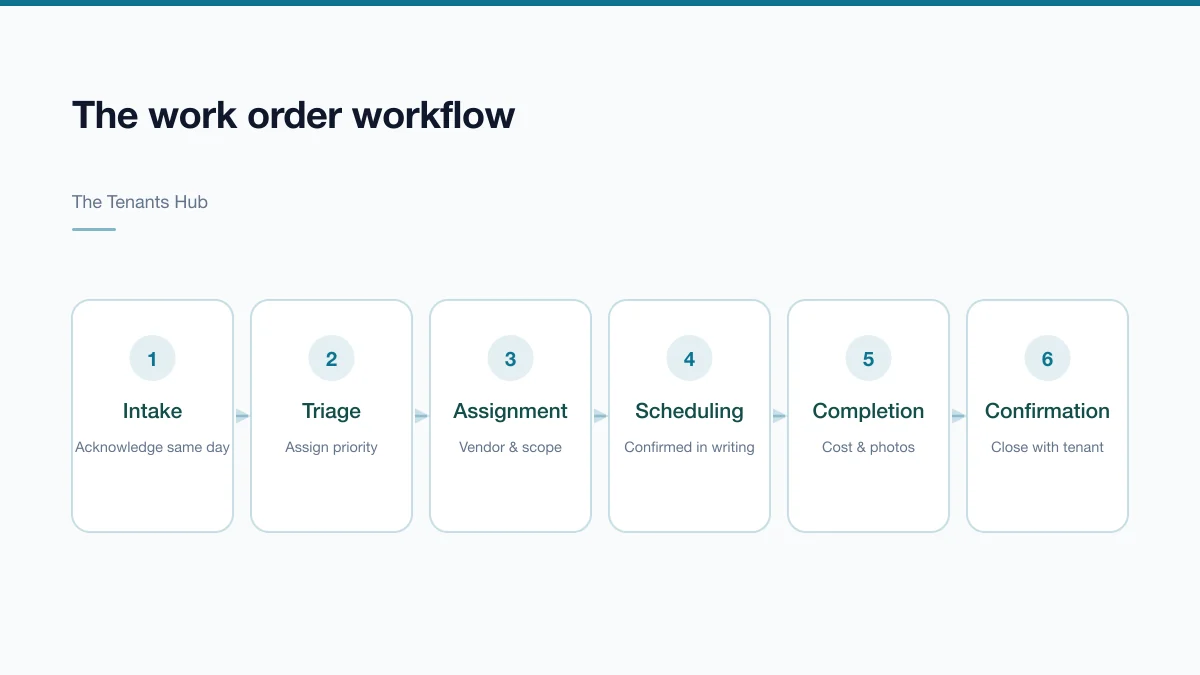
That final confirmation matters more than it looks. A repair completed but never confirmed reads to the tenant as a repair that was ignored, which is why closed tickets and satisfied tenants are not the same measurement.
Priority levels and response targets
| Priority | Examples | Target response |
|---|---|---|
| Emergency | No heat in winter, no water, sewage backup, gas smell, flooding, electrical hazard | Immediate — within hours |
| Urgent | No hot water, refrigerator failure, single-point plumbing leak, broken exterior lock | Within 24 hours |
| Routine | Dripping tap, running toilet, minor appliance fault, slow drain | Within 3–5 days |
| Cosmetic | Paint touch-up, cabinet adjustment, minor marks | Scheduled, or at turnover |
Publish these tiers to tenants. Expectations set in advance dramatically reduce follow-up contact, and a tenant who knows a routine item takes three to five days is not chasing you on day two.
The emergency tier is not merely a service standard. Loss of heat, water, or electricity generally implicates habitability directly, and the obligations can be measured in hours.
Why response time is a legal question
Nearly every US jurisdiction implies a warranty of habitability into residential leases: the landlord must keep the unit fit to live in. It typically covers structural integrity, weather protection, working plumbing and hot water, heating, safe electrical systems, and freedom from pest infestation.
Where the warranty is breached, tenant remedies commonly include:
- Repair and deduct, within statutory limits
- Rent withholding, sometimes into escrow, until the defect is cured
- Lease termination without penalty for serious and persistent defects
- A defence to eviction, which can defeat an otherwise valid non-payment case
- Damages, and in some states statutory penalties
An unanswered repair request is not just a service failure. It is the most common way a straightforward non-payment eviction turns into a contested case.
This is the direct link between maintenance records and legal outcomes — see the eviction process for how habitability defences are raised in practice.
Managing the vendor side
Your response times are limited by your contractors' availability. Build the bench before you need it.
- Keep at least two vetted vendors per trade, so one being unavailable is not an outage
- Verify licensing and insurance on file, and re-verify annually rather than once
- Agree rates and after-hours call-out charges in advance, in writing
- Set an approval threshold below which vendors can proceed without asking
- Give vendors direct access to the work order and to tenant contact details
- Track cost and completion time per vendor so renewal decisions use data
That last point compounds. After a year of tracked work orders you know which vendor is genuinely cheaper once callbacks are counted, and which quotes low and returns twice.
Budgeting and reserves
Start with a heuristic — one to two percent of property value annually, or roughly one month of rent — then replace it with your own data as soon as you have a year of tracked spend.
Keep capital replacement separate from operating maintenance. Roofs, HVAC systems, water heaters and appliances all have known useful lives, so their replacement cost can be divided across the remaining years and reserved for. A roof at year twenty-two of a twenty-five year life is a budgeting item, not a crisis. For how these are treated in the books, see rental property bookkeeping.
The Tenants Hub tracks work orders from tenant intake through vendor assignment to completion, with costs recorded against each property and a vendor portal so contractors see assigned work directly. The result is that the maintenance history — the thing that protects you — accumulates as a by-product of doing the work.