Ask ten landlords for a rent roll and you will get ten different documents — a spreadsheet, a screenshot, a handwritten list, occasionally a shrug. Ask a lender what they expect and the answer is much narrower, because the rent roll is the document their entire underwriting model is built on.
A rent roll is a point-in-time schedule of every unit in a property or portfolio, showing who occupies it, what they pay, when their lease ends, and where they stand financially. That is the whole idea. The value is entirely in whether it is complete and accurate.
Why the rent roll carries so much weight
For an income-producing property, value is a function of net operating income. The rent roll is the primary evidence of the income half of that equation, which makes it the document everyone with money at stake examines first.
- Lenders derive gross potential rent from it, apply vacancy and collection loss assumptions, subtract operating expenses and test the resulting NOI against debt service.
- Buyers and appraisers use it to distinguish in-place income from asking rents, and to find below-market leases that represent upside — or above-market ones that represent risk.
- Owners use it to spot arrears, watch lease expiration clustering, and see whether concessions are quietly eroding effective rent.
- Insurers and asset managers use unit counts, occupancy and tenancy mix for coverage and reporting.
A rent roll that disagrees with the leases behind it does not just get corrected. It changes how every other number you present is treated.
The fields a complete rent roll contains
There is no single mandated format, but there is a strong convention. Anything missing from the list below will generally be asked for.
| Field | What it holds | Why it is needed |
|---|---|---|
| Unit identifier | Unit number or address | Ties every row to a physical asset |
| Unit type | Beds, baths, square footage | Enables rent-per-square-foot comparison |
| Tenant name | Leaseholder(s), blank if vacant | Identifies the obligated party |
| Occupancy status | Occupied, vacant, notice given | Drives vacancy and exposure analysis |
| Lease start | Commencement date | Establishes tenancy length |
| Lease end | Expiration date | Shows rollover exposure |
| Monthly rent | Contract rent in force now | The core income figure |
| Market rent | Current asking rent for the unit | Quantifies loss-to-lease upside |
| Security deposit | Amount held | Reconciles against the deposit liability |
| Other charges | Parking, pet rent, utility recovery | Captures non-rent recurring income |
| Concessions | Free rent or discounts | Converts contract rent to effective rent |
| Balance / arrears | Amount past due | Reveals collection risk |
| Lease status | Current, month-to-month, holdover | Flags weak or expired tenure |
The summary figures that go underneath
The unit-level detail is the body of the document; the summary block is what most readers look at first. Derive it from the rows rather than typing it, so the two can never disagree.
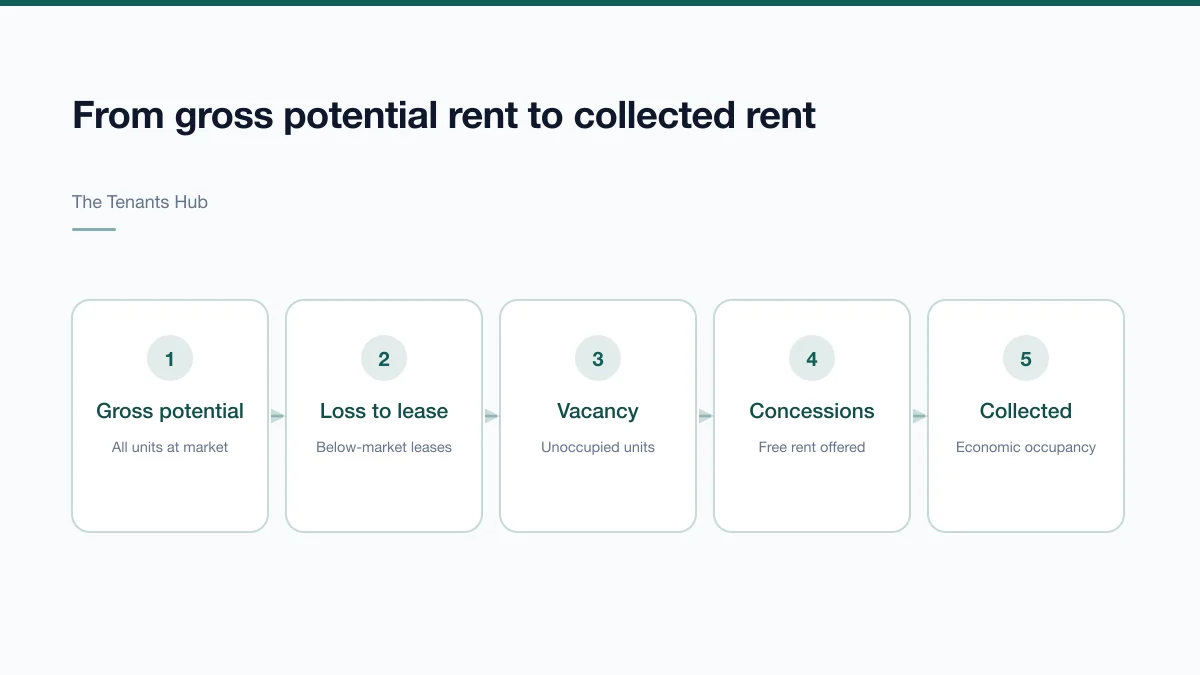
- Gross potential rent — the sum of market rent across every unit as though all were leased at asking
- Actual scheduled rent — the sum of contract rent for occupied units only
- Loss to lease — the gap between the two, showing embedded upside
- Physical occupancy — occupied units divided by total units
- Economic occupancy — actual collected rent divided by gross potential rent, which is the more honest measure
- Total deposits held — must reconcile to the deposit bank balance
- Total arrears — with an ageing breakdown at 30, 60 and 90 days
The distinction between physical and economic occupancy is where a lot of portfolios look better than they are. A property can be 100% physically occupied and still run at 88% economic occupancy once concessions, arrears and below-market leases are accounted for. Sophisticated readers go straight to that spread.
Reading lease expirations for risk
Sort the rent roll by lease end date and a different picture emerges. If a disproportionate share of a property's leases expire in the same sixty-day window, that is concentrated rollover risk — and if that window falls in your slowest leasing season, it is worse.
Well-run portfolios deliberately stagger expirations, using short or long initial terms at renewal to pull leases out of crowded months and into stronger ones. Month-to-month and holdover tenancies deserve their own attention: they offer flexibility but they are also the tenancies that can end with very little notice.
How you handle that window is a strategy question in itself — lease renewals and rent increases goes into the tradeoff between pushing rent and holding occupancy.
Where rent rolls go wrong
- Omitting vacant units. It inflates apparent occupancy and is discovered immediately in lease audit.
- Showing asking rent as contract rent. Contract rent is what the signed lease says, not what you hope to get.
- Ignoring concessions. Two months free on a twelve-month lease is a sixteen percent reduction in effective rent, and it belongs on the document.
- Stale data. A rent roll edited by hand drifts from the underlying leases within weeks.
- Counting non-recurring income as rent. Late fees and one-off charges are not scheduled rent and should not sit in that column.
- Deposits that do not reconcile. If deposits held do not match the deposit account balance, expect questions about how client funds are handled.
Building a rent roll you can produce on demand
The practical goal is that a rent roll takes seconds rather than a weekend. That only happens when the document is generated from the lease records rather than maintained separately.
If a lease is signed, renewed or terminated in your system, the rent roll should already reflect it. If a payment posts, the arrears column should already be right. When those things are true, the rent roll stops being a report you dread and becomes a live view of the portfolio you can check on any given morning.
The Tenants Hub derives rent rolls directly from lease and payment records, including vacancies, deposits held and arrears ageing, so the version you hand a lender is the same data you manage from. For what sits alongside it in your books, see rental property bookkeeping.