Turnover is the most under-measured cost in residential property management. It does not appear as a line item, it arrives in pieces across two or three months, and by the time the unit is re-leased the total has been absorbed into general operating expense and forgotten.
Measured properly, it changes decisions. A landlord who knows a turnover costs them $4,200 evaluates a $75 rent increase very differently from one who has never added it up.
Calculating what a turnover really costs
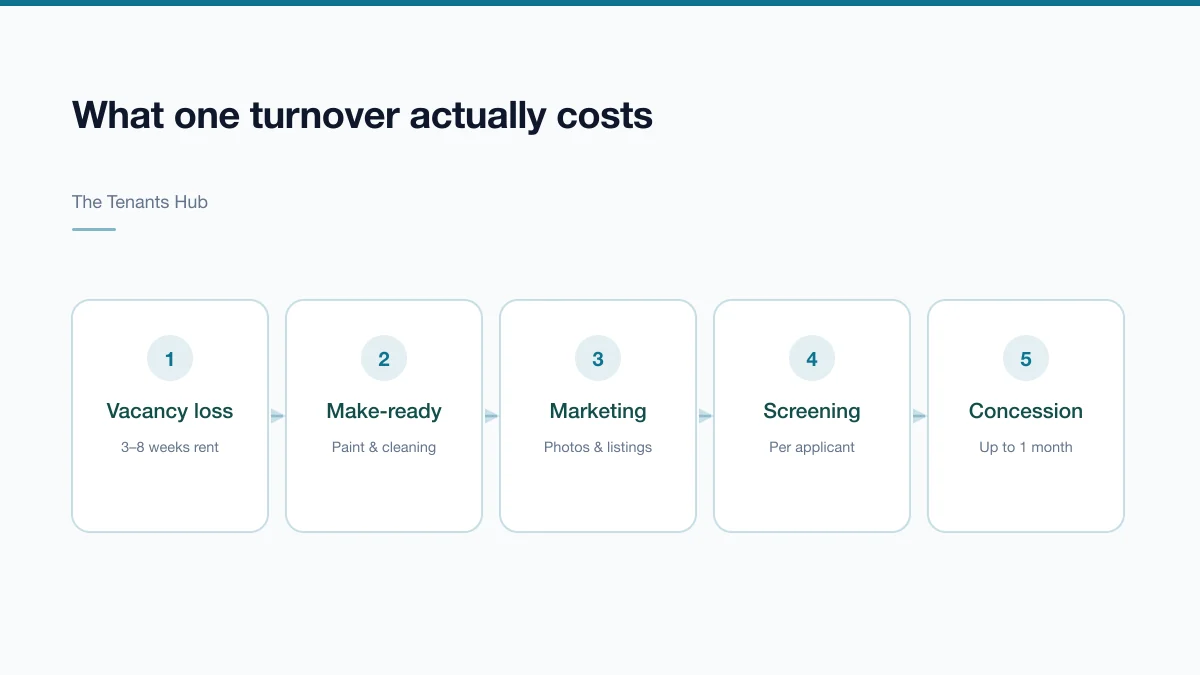
Work through the components for one of your own units. The figures below are illustrative — the exercise is to replace them with yours.
| Component | Typical range | Example |
|---|---|---|
| Vacancy loss | 3–8 weeks of rent | $2,100 (3.5 weeks) |
| Make-ready: paint | Partial or full repaint | $600 |
| Make-ready: cleaning | Deep clean and carpets | $350 |
| Repairs beyond deposit | Variable | $300 |
| Marketing and listing | Photos, syndication | $150 |
| Showing and leasing time | Your time or a fee | $400 |
| Screening | Per applicant | $75 |
| Concession to new tenant | 0–1 month | $0–1,800 |
| Total | 1.5–3x monthly rent | $3,975+ |
The headline number matters less than the comparison it enables. In this example, retaining the tenant is worth roughly $4,000 — which reframes almost every renewal conversation, every borderline repair request, and every decision about how hard to push rent.
A tenant who stays a fourth year has effectively paid you a turnover cost you never had to spend.
Why tenants actually leave
Some departures are entirely outside your control — a job relocation, buying a home, a change in household size, moving in with a partner. There is no retention strategy for these, and trying to counter them wastes effort.
The controllable reasons are a shorter list, and they are consistent:
- A rent increase that felt arbitrary. Not the amount so much as the absence of context or warning.
- Maintenance that went unanswered. Especially requests that were acknowledged and then went quiet.
- Poor communication. Slow replies, no clear channel, or having to chase for basic answers.
- Unresolved neighbour or building problems. Noise, parking, shared-area conditions that the tenant reported and nothing changed.
- A renewal offer that arrived too late. By the time it landed, the tenant had already toured other units.
- Feeling like a transaction. Zero contact for a year, then a rent-increase letter.
Every one of those is addressable at low cost, which is what makes retention such favourable economics compared with almost any other operational improvement.
Retention tactics that pay for themselves
Start the renewal conversation 90 days out
Most landlords send a renewal notice 30 to 45 days before expiry. By then a tenant considering a move has already been looking for weeks. Opening the conversation at 90 days puts you first, and gives you time to negotiate rather than react.
Ninety days also gives you a real option if they decline: you can market the unit early and cut the vacancy gap substantially.
Make rent increases small and predictable
A modest annual increase that the tenant expects is far better received than a flat year followed by a large correction. Explain the basis briefly — market movement, tax or insurance changes, improvements made. Silence invites the assumption that the number is arbitrary.
Where a unit has drifted well below market, consider staging the correction across two renewals rather than closing the gap at once. Lease renewals and rent increases works through that tradeoff in more detail.
Acknowledge every request the same day
The perception of responsiveness is driven more by acknowledgement than completion. A same-day reply that confirms the request was received, says what happens next and gives a realistic timeframe changes the experience even when the actual repair takes a week to schedule.
The failure mode is silence: a request that vanishes into a message thread with no status. That is why requests should become tracked tickets — covered in rental property maintenance planning.
Offer improvements instead of discounts
A tenant weighing renewal against moving responds well to a concrete improvement — new appliance, fresh paint in the main room, updated fixtures, ceiling fan. It costs less than a month of vacancy, it improves the asset permanently, and unlike a rent discount it does not reset your baseline for the next negotiation.
Use lease term as a lever
Not every tenant wants twelve months. Offering eighteen or twenty-four at a slightly better rate rewards the tenants you most want to keep, and lets you move expirations out of your weakest leasing season into your strongest.
Make contact when nothing is wrong
A brief mid-term check-in — a message asking whether anything needs attention — surfaces small problems before they become renewal objections, and materially changes how the relationship feels. It is close to free and disproportionately effective.
Measuring retention properly
You cannot improve what you do not track. Four metrics are enough:
- Turnover rate — move-outs in a period divided by total units
- Renewal rate — renewals divided by leases that came up for renewal
- Average tenancy length — trending over time rather than as a single figure
- Days vacant per turnover — from move-out to the new tenancy start, not to listing
Record the stated reason for every move-out, even briefly. After a dozen departures the pattern is usually obvious, and it is often not what you assumed — a cluster of maintenance-related exits points somewhere very different from a cluster of price-related ones.
Making it operational
Retention fails on timing more than intent. The renewal window passes, the maintenance request slips, the check-in never happens — not because anyone decided against them, but because nothing surfaced them at the right moment.
The Tenants Hub surfaces lease expirations well ahead of the renewal window, keeps maintenance requests as tracked work orders with status visible to the tenant, and holds communication against the tenant record. That turns retention from a set of good intentions into a set of things that appear on a screen in time to act on.