Eviction is the part of property management everyone hopes to avoid and few handle well the first time. It is worth being clear about what it actually is: a formal civil lawsuit for possession of real property, governed by procedural rules that courts apply strictly.
That strictness is the central practical fact. When landlords lose eviction cases, it is usually not because the tenant did not owe the rent. It is because the notice period was one day short, the notice was served in a manner the statute does not authorise, the amount demanded included late fees the lease did not support, or the ledger presented to the court did not reconcile.
Before you start: is eviction the right move?
Eviction is slow and expensive, and it usually ends with a judgment against someone who cannot pay it. Court costs, attorney fees, weeks of lost rent, turnover and repairs frequently exceed the arrears being pursued.
That is not an argument for tolerating non-payment. It is an argument for testing the alternatives first, quickly, and documenting that you did:
- A written repayment plan with specific dates and amounts, for a tenant with a temporary and identifiable problem
- A cash-for-keys agreement — paying an agreed sum for a voluntary surrender on a fixed date, in writing
- A mutual lease termination that ends the tenancy cleanly without a court record
- A referral to local rental assistance programmes, which in some areas will pay arrears directly
These often resolve faster and cheaper than filing. Where they do not, the documented attempt strengthens your position rather than weakening it.
Stage 1: The statutory notice
Almost every eviction begins with a written notice giving the tenant a defined period to fix the problem or leave. Filing before the notice period has fully expired is the single most common reason cases are dismissed.
| Notice type | Used when | Tenant's option |
|---|---|---|
| Pay or quit | Rent is unpaid | Pay the stated amount or vacate |
| Cure or quit | A curable lease violation | Fix the violation or vacate |
| Unconditional quit | Serious or repeated violations | Vacate — no cure right |
| Termination of tenancy | Ending a month-to-month tenancy | Vacate by the stated date |
| Non-renewal | Lease term ending | Vacate at expiration |
For the notice to hold up, it generally must:
- Name every adult tenant on the lease, spelled as the lease spells them
- State the property address precisely, including the unit
- State the exact amount owed — and only amounts the lease and state law actually permit
- Give the full statutory period, counted the way the statute counts it
- Be served by a method the statute authorises
- Be dated, and retained with proof of how and when it was delivered
Counting days is its own trap. Jurisdictions differ on whether the count uses calendar or business days, whether the service day counts, and whether extra days are added for mailed service. Getting this wrong by one day restarts the whole process.
Stage 2: Filing the complaint
If the notice period expires without cure or surrender, you file an eviction action — variously called unlawful detainer, forcible entry and detainer, summary possession or dispossessory, depending on where you are.
The filing package typically includes the complaint, a copy of the lease, a copy of the notice with proof of service, and a ledger showing the arrears. That ledger matters more than landlords expect: a payment history that does not reconcile — unexplained credits, inconsistent late fees, payments applied in an order the lease does not describe — invites the court to question the whole claim.
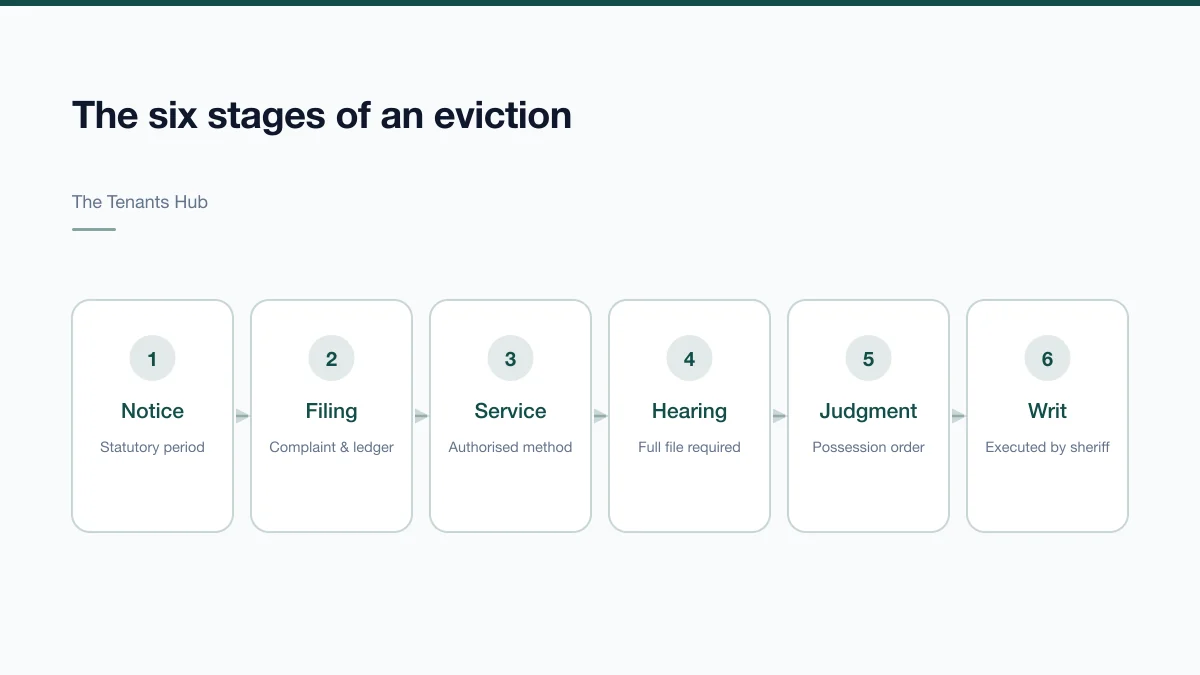
Stage 3: Service of the summons
The tenant must be formally served with the summons and complaint by an authorised party — usually a sheriff, marshal or licensed process server, not you. Statutes generally set a hierarchy: personal service first, then substituted service on a suitable adult at the residence, then posting and mailing only if the earlier methods have genuinely been attempted.
Skipping straight to posting because it is easier is a defect a represented tenant will find. Proof of service is filed with the court and becomes part of the record.
Stage 4: The hearing
If the tenant does not respond within the statutory window, you may be able to seek a default judgment. If they do respond, the matter is set for hearing — often within one to three weeks, though busy courts run considerably longer.
Bring the complete file, organised:
- The signed lease and every addendum and renewal
- A clean, reconciled payment ledger for the entire tenancy
- The notice, with dated proof of service
- All written communication with the tenant about the default
- Photographs or inspection records, where the case concerns condition or violation
- Proof of ownership or of your authority to act for the owner
Common tenant defences you should expect and be able to answer:
- Defective notice — wrong period, wrong amount, wrong service method
- Rent was paid, or was tendered and refused
- Breach of the warranty of habitability, where conditions went unrepaired
- Retaliation, particularly where the tenant recently complained or contacted a code authority
- Discrimination under fair housing law
- Improper service of the summons
- Failure to register the property or obtain a required rental licence, which in some cities bars an eviction outright
The habitability defence is the one most often underestimated. An unaddressed repair request sitting in an inbox can turn a straightforward non-payment case into a contested one.
This is a concrete reason to keep maintenance requests on a tracked system with dates and resolutions rather than in messages — see building a rental property maintenance plan.
Stage 5: Judgment and writ of possession
A judgment for possession does not by itself let you take the unit back. Most states give the tenant a short window to vacate voluntarily. If they do not, you request a writ of possession, which is the order authorising law enforcement to remove them.
The writ is executed by the sheriff or marshal on their schedule, which can add days or weeks. The landlord does not carry out the removal. Handling of belongings left behind is separately regulated — many states require storage for a defined period and specific notice before disposal.
A money judgment for unpaid rent and costs is often entered alongside the possession judgment, but collecting it is a separate matter with its own process and, realistically, a low recovery rate.
The one thing never to do
Do not attempt self-help eviction. Changing the locks, removing the door, cutting power or water, or putting a tenant's possessions on the pavement is unlawful in essentially every US jurisdiction — no matter how much rent is owed or how clearly the tenant is in the wrong.
Consequences typically include statutory damages, liability for the tenant's attorney fees, a court order restoring possession, and in some states criminal exposure. It also hands a tenant with no defence a very good one.
Documentation is the whole game
Every stage above turns on records: what the lease says, what was paid and when, what notice was served and how, what was communicated, what was repaired. Landlords who lose winnable cases almost always have the facts and not the file.
Keeping the lease, the payment ledger, the maintenance history and the notice record on one tenant file — rather than across a spreadsheet, an inbox and a filing cabinet — is what makes the file producible on a week's notice. The Tenants Hub tracks eviction cases against the lease record with the supporting payment and communication history attached, so the evidence assembles as the case progresses rather than afterwards.
The best eviction remains the one that never happens, which puts most of the leverage back at the start of the tenancy — see how to screen tenants.